
Every six months, like clockwork. That is what most of us were told growing up in Australia, and most of us never questioned it. You finish your clean, the receptionist books you in for six months’ time, and the cycle repeats. But here is the thing – that six-month rule was never really based on solid science. It stuck because it was easy to remember and easy for health funds to build policies around, not because a room full of researchers agreed it was the magic number.
So how often do you actually need teeth cleaning in Perth? It depends on your mouth, your habits, and your risk factors. For some people, six months is spot on. For others, it is too often – or not nearly enough. Let us walk through what the evidence says and how to figure out where you sit.
Where the 6-Month Rule Actually Came From
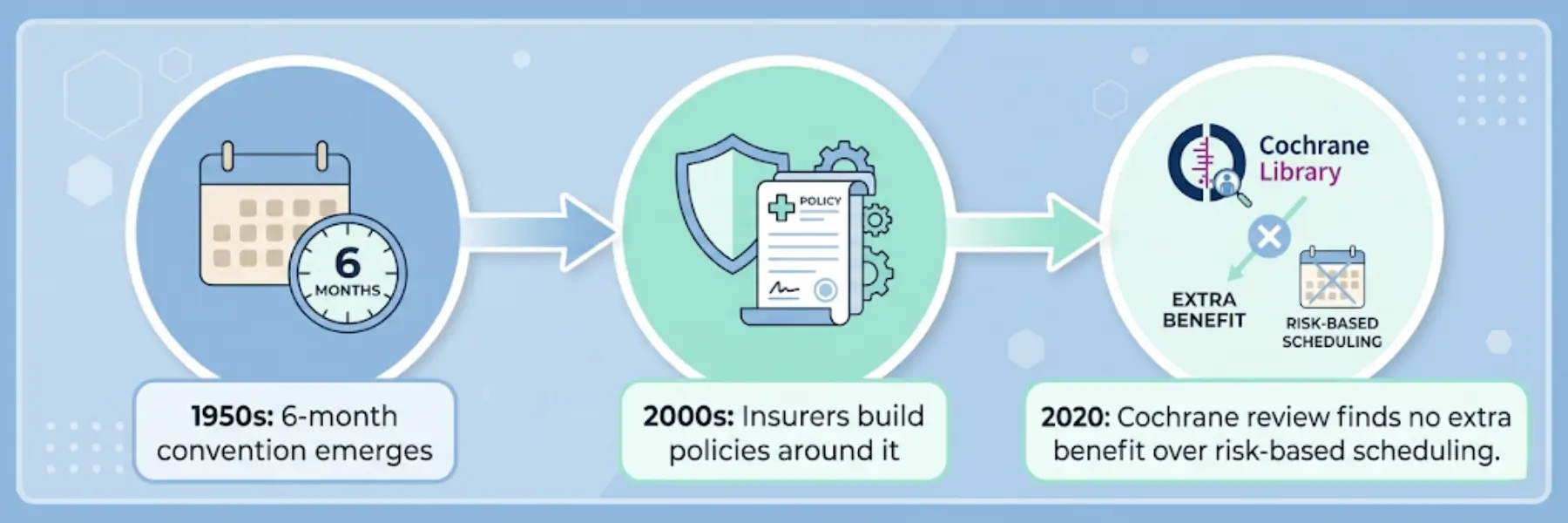
The idea of visiting your dentist twice a year did not come from a landmark clinical study. It became popular in the mid-20th century, partly through advertising and partly because health insurers built their policies around six-monthly intervals. Over time, it simply became “what everyone does.”
That does not mean it was wrong. It was a reasonable default. But it was never based on strong clinical evidence, and dental professionals have known this for years. The Australian Dental Association (ADA) and Healthdirect Australia both now recommend check-ups every 6 to 12 months, depending on individual risk (Healthdirect Australia, “Dental care and teeth cleaning,” accessed August 2026).
The six-month interval became the norm because it was easy to remember, easy to schedule, and easy to insure, not because the science demanded it.
What the Research Actually Says About Dental Cleaning Frequency
Two Cochrane reviews looked at this question closely:
- The 2018 Cochrane review on routine scale and polish (Lamont et al., 2018) examined whether regular scaling and polishing at fixed intervals offered clear benefits for adults who were already at low risk of gum disease. The evidence was insufficient to confirm or deny that routine scaling at set intervals prevents periodontal disease in healthy adults.
- The 2020 Cochrane review on dental check-up intervals (Fee et al., 2020) included results from the UK INTERVAL trial involving over 1,700 participants. It provided high-certainty evidence that whether adults attend every six months or at personalised, risk-based intervals, the outcomes for tooth decay, gum disease, and overall wellbeing are comparable (Cochrane Library, “Recall intervals for oral health in primary care patients,” October 2020).
In plain terms: for many people, a rigid six-monthly schedule offers no additional protection compared to a risk-based approach where your dentist sets the interval based on your mouth.
This is not an argument against professional dental cleaning. It is an argument for the right schedule, tailored to your actual needs.
Who Genuinely Needs a Clean Every 3 to 4 Months
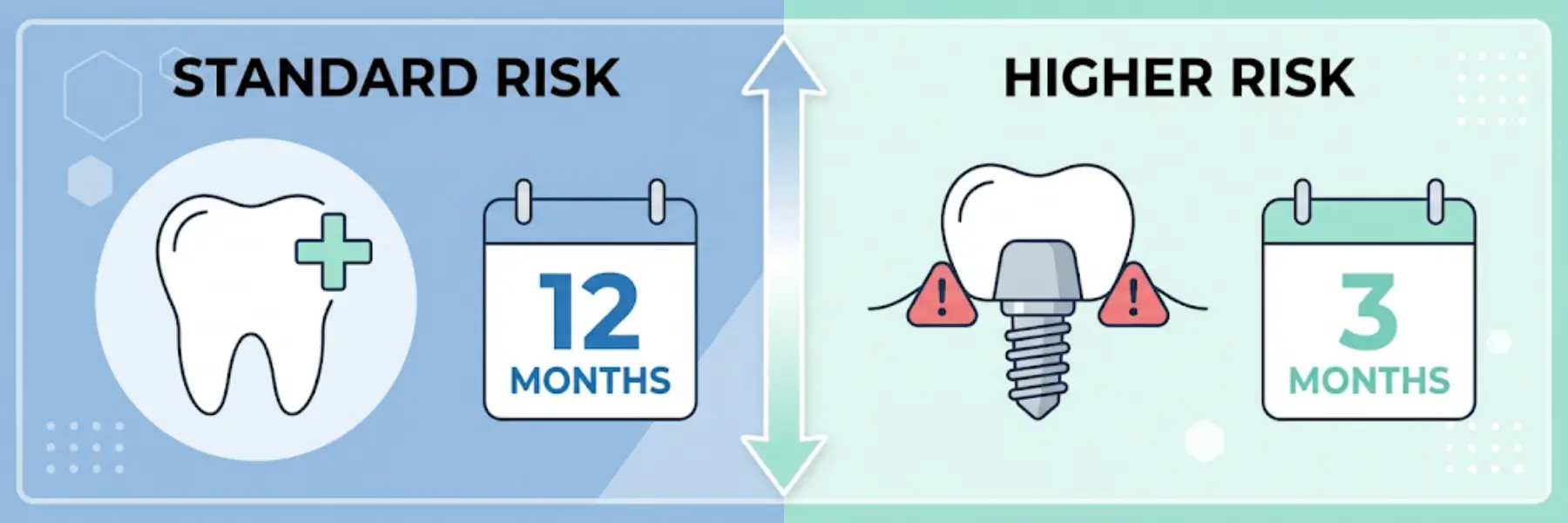
Some patients do need more frequent visits than the standard six or twelve months. If any of the following apply to you, a shorter recall interval is not over-servicing; it is preventive care that protects your long-term oral health:
- Dental implant patients – Implants cannot get cavities, but the gum tissue around them can develop peri-implantitis, a serious inflammatory condition that can lead to implant failure. Dental implant patients benefit from more frequent professional cleaning to protect their investment. Regular monitoring catches early signs before they become costly problems.
- Patients with a history of gum disease – Once you have had periodontitis, you are at higher risk of recurrence. Three to four-monthly maintenance visits help keep things stable.
- Diabetics – Diabetes and gum disease have a two-way relationship. Poorly controlled blood sugar increases infection risk in the gums, and untreated gum disease can make blood sugar harder to manage.
- Smokers and vapers – Tobacco reduces blood flow to the gums, slows healing, and accelerates tartar build-up.
- Heavy plaque builders – Some people simply produce calculus faster than others, regardless of how well they brush. Your dental hygienist in Perth can identify this pattern.
- Orthodontic patients – Braces and clear aligners like Invisalign create extra surfaces where plaque can accumulate, making more frequent cleans a smart move during treatment.
Who Can Safely Stretch to Annual Visits
Not everyone needs to come in twice a year. You may be fine with a 12-monthly check-up and clean if you:
- Have no active decay or history of frequent cavities
- Show no signs of gum disease at your last visit
- Do not smoke or vape
- Maintain a solid home care routine (brushing twice daily, flossing, using fluoride toothpaste)
- Have no implants, bridges, or complex dental work
That said, keep an eye out for warning signs that mean you should come in sooner:
- Bleeding gums when you brush or floss
- Persistent bad breath or a metallic taste in your mouth
- Tooth sensitivity to hot, cold, or sweet food and drinks
- A tooth that feels loose or “different” when you bite down
If any of these show up between scheduled visits, do not wait. Book a routine dental check-up and clean at Mia Dental Centre sooner rather than later.
What a Professional Clean Actually Does
A professional scale and clean is not the same as a thorough brushing at home. Here is what happens during a typical appointment:
- Ultrasonic scaling removes calcified tartar (calculus) that sits above and below the gumline. Once plaque hardens into tartar, no amount of brushing or flossing can shift it.
- Hand scaling reaches stubborn deposits in tight areas that the ultrasonic instruments may miss.
- Polishing smooths the tooth surfaces after scaling. Smoother surfaces give bacteria less to grip onto, which slows plaque formation between visits.
- Fluoride application helps remineralise early decay spots, essentially strengthening weakened enamel before a cavity forms.
Beyond the clean itself, your dental hygienist screens for issues you would never catch on your own:
- Oral cancer screening – checking soft tissues for unusual changes
- Gum pocket measurements – deeper pockets indicate progressing gum disease
- Early decay detection – small cavities are often invisible to the naked eye
A professional clean is as much about what is found as what is removed.
The Perth-Specific Context: Getting the Most From Your Health Fund
If you are in Perth and have private health insurance, there is a good chance your fund covers at least one preventive dental clean per year. HBF, WA’s largest health fund, offers 100% back on the first scale and clean each year on select extras covers, with no annual limit on preventive dental for certain policies.
Despite this, many Perth residents leave their preventive dental benefits unused each year. (Finding current stat: HBF does not publicly report suburb-level utilisation data. To obtain accurate figures, request the latest HBF annual claims report or contact HBF’s corporate relations team directly.)
If your fund gives you one no-gap clean per year, use it, even if you are on an annual schedule. It is literally included in what you are already paying for.
Timing tip: Perth dental clinics, including our Wanneroo practice, tend to see booking spikes in January (new year health resolutions) and July (when health fund benefit limits reset at the end of the financial year). If you want a shorter wait time, book in February, March, or August.
You can visit our Wanneroo clinic to discuss your ideal recall schedule, or explore our general family dentistry services to see how we tailor preventive care to every patient.
Frequently Asked Questions
Does a scale and clean hurt?
Most patients feel some pressure and occasional sensitivity, particularly around areas with heavy tartar build-up. If you have sensitive teeth or dental anxiety, let your hygienist know beforehand. Mia Dental Centre also offers sleep dentistry options for patients who need extra comfort during procedures.
How long does a scale and clean take?
A standard scale and clean typically takes 30 to 45 minutes. If there is significant tartar build-up or it has been a while between visits, it may take a little longer.
Can I eat afterwards?
Yes. If you had a fluoride treatment, your dentist may recommend waiting 30 minutes before eating or drinking to give the fluoride time to absorb. Otherwise, you are fine to eat straight away.
What is the difference between a standard clean and a deep clean?
A standard clean (also called a prophylactic clean or “prophy”) removes plaque and tartar from the tooth surfaces above and just below the gumline. A deep clean, or scaling and root planing, goes further beneath the gumline and smooths the root surfaces. Deep cleans are typically recommended for patients with active gum disease and are a different procedure with different goals. Learn more about what our team offers through our general family dentistry page.