
On 1 April 2026, health insurance premiums across Australia went up by an average of 4.41% – the largest increase in nine years (Australian Government Department of Health, “2026 Private Health Insurance Premiums,” February 2026). For a family paying $250 a month for extras cover, that works out to roughly $130 more per year. It is no wonder more Perth households are asking whether dental extras are still worth it, or whether dental payment plans in Perth might be a smarter way to manage the cost.
The short answer: it depends on how often you use your cover. But what has changed is the range of options available. Let us break down each one.
The BNPL Shift in Australian Dental Care
Buy now, pay later is no longer just for online shopping. As of March 2026, 41% of Australians have used a BNPL service in the past six months, with adoption highest among younger age groups – 59% of Gen Y and 57% of Gen Z (Finder Australia, “Buy now pay later statistics,” April 2026). Healthcare, including dental, is one of the fastest-growing sectors for BNPL adoption, with providers like Afterpay, Zip, and Humm now accepted at dental practices across Perth.
For families feeling the cost-of-living squeeze, these options are filling a gap that traditional health insurance is leaving behind.
Your Options: A Plain-English Breakdown
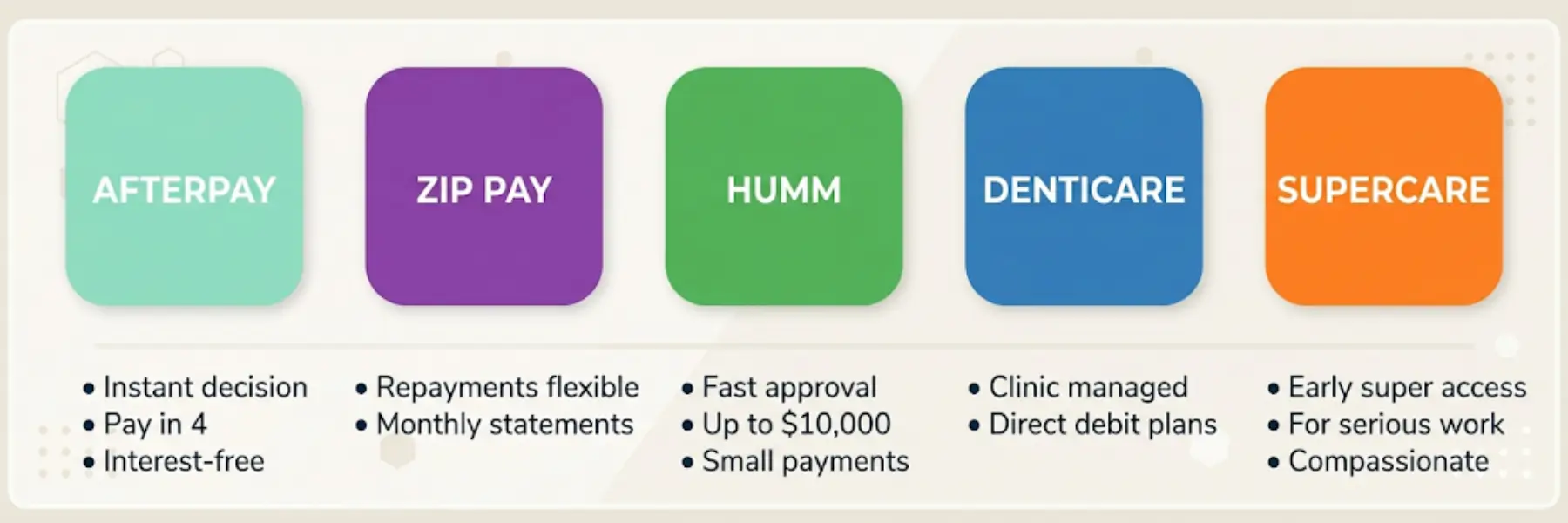
Here is what each dental payment plan actually involves, what it costs, and who it suits.
Afterpay
- How it works: Split your bill into 4 interest-free payments over 8 weeks.
- Spend limits: Typically $1,000 to $2,000 depending on your account history.
- Fees: No interest. Late fees apply if you miss a payment.
- Credit check: No hard credit check for standard accounts.
- Suits: Check-ups, cleans, simple fillings, teeth whitening – anything under $2,000.
Zip Pay
- How it works: Interest-free credit line up to $1,000 with flexible repayment.
- Fees: $0 if you pay your balance in full each month. A $9.95 monthly account fee applies if you carry a balance.
- Credit check: Soft credit check on sign-up.
- Suits: Smaller treatments where you want more flexibility than Afterpay’s 8-week window.
Zip Money
- How it works: For larger amounts ($1,000 to $5,000+). Interest-free periods vary by promotion. After the interest-free period, a standard rate applies.
- Fees: Establishment fee and monthly account fee apply.
- Credit check: Full credit check required.
- Suits: Mid-range treatments like crowns, root canals, or multiple fillings in one visit.
Humm
- How it works: Finance up to $30,000 with no interest ever on the “little things” (under $2,000) and interest-free terms on larger amounts.
- Repayment: Structured over 6 to 60 months depending on the amount.
- Suits: Major dental work – dental implants, All-on-4, full-arch rehabilitation, orthodontics. If you are looking at treatment in the $5,000 to $30,000 range, Humm is built for this.
DentiCare
- How it works: Interest-free payment plans designed specifically for dental treatment. Repayments are structured around your treatment plan timeline.
- Fees: No interest. A small direct debit fee may apply.
- Suits: Any treatment amount. Widely accepted at Australian dental practices.
Fund My Dental
- How it works: Choose from weekly payment plans starting at $39 or $79 per week. No interest. No credit check.
- Suits: Patients who prefer a simple weekly budget approach without signing up for a BNPL app.
Super Release (Early Superannuation Access)
- How it works: The Australian Government allows early release of superannuation for essential medical and dental treatment that is not purely cosmetic. You will need a letter from your dentist or GP confirming the treatment is medically necessary.
- Processing time: Expect 2 to 4 weeks for approval through the ATO.
- Suits: Major procedures where other payment options do not cover the full amount. Particularly useful for implant cases, full-mouth rehabilitation, or extensive surgical work.
Child Dental Benefits Schedule (CDBS)
- How it works: The Australian Government provides up to $1,095 per eligible child (aged 0 to 17) over two consecutive calendar years. Covers check-ups, cleans, fillings, extractions, fissure sealants, and root canals on baby teeth.
- Eligibility: Your family must receive Family Tax Benefit Part A or certain other government payments. Services Australia will notify you if your child is eligible.
- Cost: At participating dentists who bulk-bill CDBS, there is zero out-of-pocket cost. At non-bulk-billing practices, you pay upfront and claim the rebate from Medicare.
- How to check your child’s balance: Log in to your Medicare online account through myGov, or call Services Australia on 132 011.
Note: Not all dental practices bulk-bill CDBS. Check with your chosen clinic before booking to confirm whether they participate. You can learn more about CDBS and government dental schemes on our financing page.
How to Choose the Right Option for Your Situation
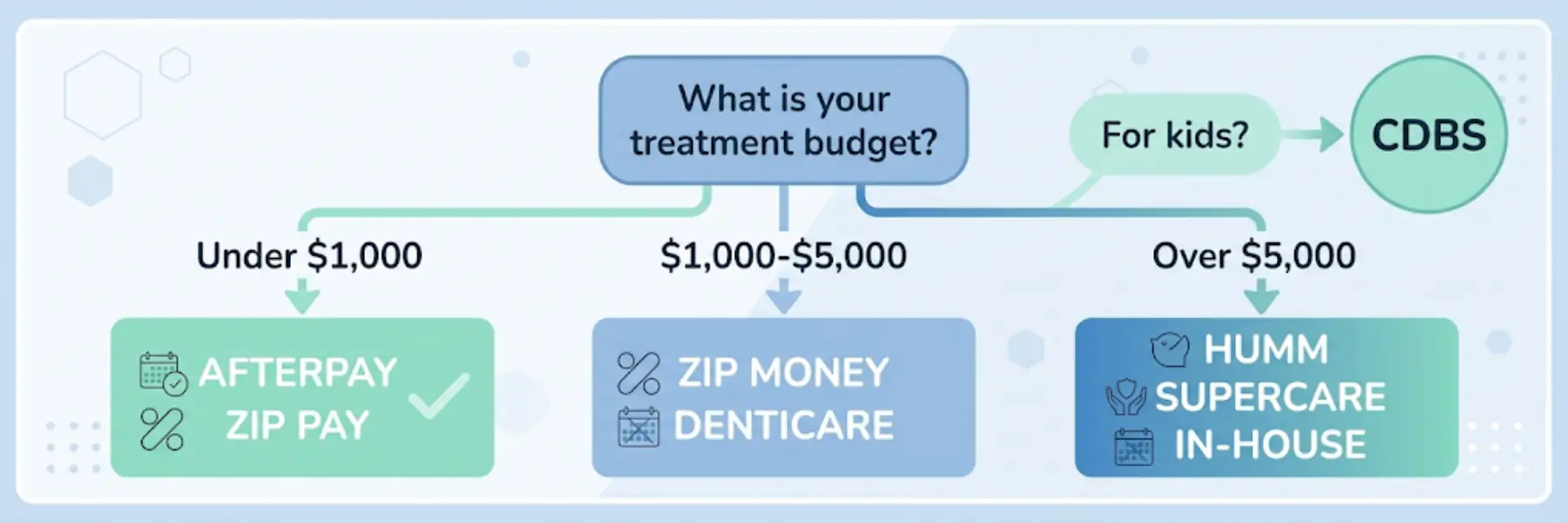
The right plan depends on the size of the bill:
- Under $1,000 – Afterpay or Zip Pay. Quick to set up, no interest, paid off within weeks.
- $1,000 to $5,000 – Zip Money, DentiCare, or Fund My Dental. Longer repayment terms, still interest-free in most cases.
- Over $5,000 – Humm, Super Release, or a combination of health fund rebate plus a payment plan. For major work like implants or full-arch treatment, these options let you spread the cost over months without delay.
- For your kids – Check CDBS eligibility first through myGov. If your child qualifies, it may cover the entire cost of their routine dental care.
You can also combine options. For example, claim your health fund rebate through HICAPS on the spot, then put the remaining gap on Afterpay or Humm. See all the payment options at Mia Dental Centre for details on what we offer.
So, Is Dental Extras Cover Still Worth It?
This is the question everyone is asking after the April premium increase. Here is a simple way to think about it.
If you and your partner each get two check-ups and cleans a year, plus one or two fillings between you, dental extras typically covers most of that. The rebates add up, and you are probably getting good value from your premiums.
But if you only visit the dentist once a year for a basic clean, the maths might not stack up. A standard check-up and clean in Perth generally costs between $200 and $350 out of pocket. Compare that to what you are paying annually in extras premiums – if the premium is higher than what you would spend on dental care, you are paying more for the insurance than the treatment itself.
That does not mean you should cancel your extras tomorrow. Extras cover is also your safety net for unexpected dental emergencies, and it covers other services like optical and physio. But if dental is the main reason you hold extras, it is worth doing the maths once a year – especially after a premium increase.
For more on managing dental costs and understanding your cover, visit our dental financing and payment support page or explore what is covered under your health fund at Mia Dental Centre.
Ready to Sort Out Your Dental Payment Plan?
Mia Dental Centre offers Afterpay, Humm, Zip Money, Zip Pay, DentiCare, Fund My Dental, and Super Release. We also accept all health funds and process claims on the spot with HICAPS.
Call us on (08) 9206 0058 or book online to discuss which option works for your situation.
Frequently Asked Questions
Can I use Afterpay at the dentist?
Yes. A growing number of Perth dental practices accept Afterpay, including Mia Dental Centre. You split your payment into 4 interest-free instalments over 8 weeks, paid fortnightly.
Do dental payment plans affect my credit score?
Afterpay and Zip Pay use soft credit checks that do not affect your credit score. Zip Money and Humm (for larger amounts) may involve a full credit check, which can appear on your credit file. DentiCare and Fund My Dental do not require credit checks.
Can I use CDBS and a payment plan together?
Yes, but for different services. CDBS covers eligible children’s dental treatment through Medicare. If there are additional costs not covered by CDBS (for example, orthodontic work), you can use a payment plan for the remainder.
What if my treatment costs more than my Afterpay limit?
You can combine Afterpay with another payment method. For example, pay part of the cost using your health fund rebate via HICAPS and cover the gap with Afterpay. Alternatively, for larger amounts, Humm or Zip Money may be a better fit.