
You sit down in the dental chair expecting a routine clean, and the dentist says you actually need a “deep clean.” Straight away, your mind goes to the price tag. Maybe a mate told you it is just a regular clean with a fancier name. Maybe you have read online that the whole thing is an upsell. The scepticism is completely understandable.
But a standard scale and clean and a deep clean really are two different procedures, designed for two different situations. They treat different problems, take different amounts of time, and yes, they cost different amounts. Once you understand what each one involves and why your dentist might recommend one over the other, the whole experience starts to feel a lot less like guesswork and a lot more like informed healthcare.
The standard scale and clean, in one paragraph
A routine scale and clean is what most people picture when they think of a dental cleaning. Your dental hygienist or dentist uses an ultrasonic scaler and hand instruments to remove plaque and tartar (also called calculus) from the visible surfaces of your teeth, above the gumline. They then polish the teeth to smooth out surface stains. The whole appointment typically takes 30 to 45 minutes, sits within your regular six-monthly dental check-up, and is a preventive measure designed to keep healthy gums healthy.
What a deep clean (scaling and root planing) actually is
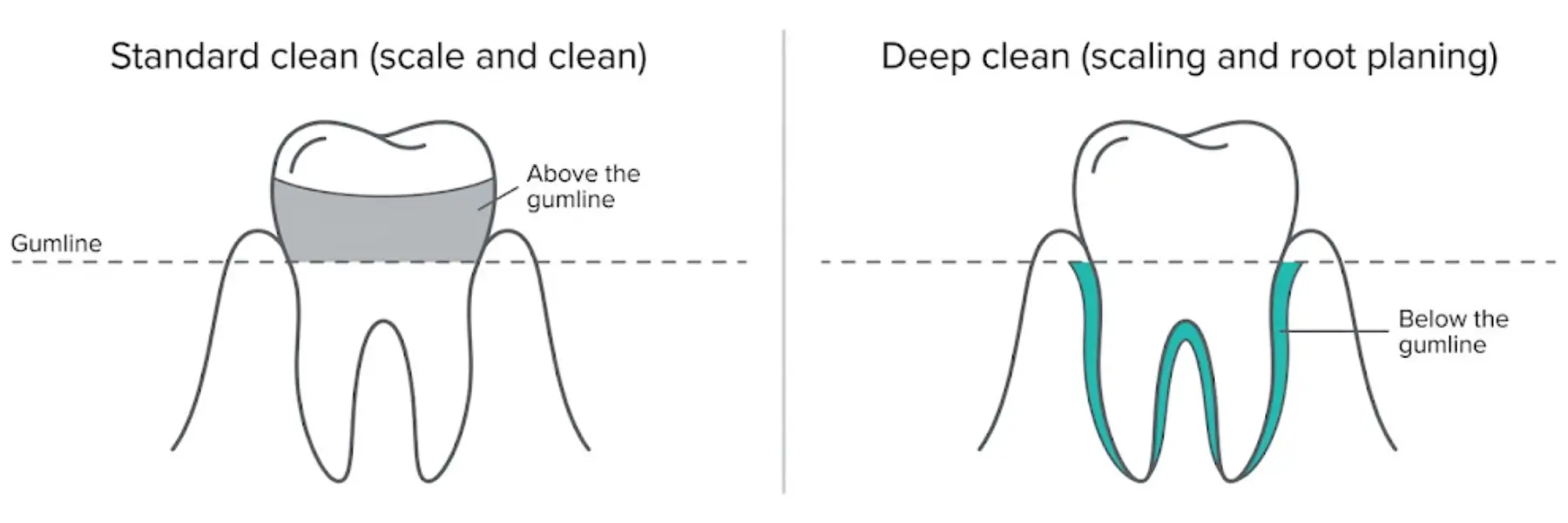
A deep clean goes further, literally. Scaling and root planing is a therapeutic procedure used to treat active gum disease (periodontitis). Instead of cleaning only above the gumline, your dentist works below it, removing hardened tartar and bacteria from the root surfaces of your teeth and the periodontal pockets that have formed around them.
The “root planing” part involves smoothing the root surface so that the gum tissue can reattach more firmly to the tooth. This is not cosmetic. It is infection control.
In most cases, local anaesthetic is used to keep you comfortable, and the procedure may be split across two appointments so each side of the mouth is treated thoroughly.
The signs that point to a deep clean
Not everyone needs scaling and root planing. Your dentist will assess your gum health at every check-up using specific clinical indicators.
Bleeding gums and pocket depths
Healthy gum pockets typically measure between one and three millimetres. When your dentist uses a periodontal probe (a thin instrument placed gently between the tooth and the gum), readings of four millimetres or more suggest that the supporting tissue is breaking down. Combine deeper pockets with gums that bleed on probing, and the picture starts pointing toward active periodontal disease rather than simple surface-level build-up.
Tartar below the gumline
Tartar that sits above the gumline is visible and relatively straightforward to remove. Subgingival tartar, the kind that forms below the gumline on the root surface, is a different story. You cannot see it, you cannot brush it away, and it creates a rough surface where bacteria thrive. When your X-rays or clinical exam reveal subgingular deposits, a standard scale and clean simply will not reach them.
Why the deep clean costs more
It is a fair question, and the answer is straightforward. A deep clean takes more time, requires more skill, and involves additional resources.
Here is what typically contributes to the higher fee:
- Anaesthetic is usually required to keep you comfortable during subgingival work
- Longer appointment times, often 60 to 90 minutes per session, and sometimes two sessions are needed
- Specialist instruments designed to access root surfaces below the gumline
- Additional diagnostic work such as periapical X-rays and detailed periodontal charting
- Follow-up appointments to reassess pocket depths and healing progress
For a transparent breakdown of what different dental procedures cost at Mia Dental Centre, visit our pricing page. You can also view the detailed pricing structure on our dental implant cost page, which outlines how treatment fees are itemised across procedures. If you are concerned about managing costs, Mia Dental Centre offers flexible payment plans that help you access the treatment you need without delay.
How the dentist decides, and how you know it was justified
Your dentist does not guess. The decision between a standard clean and a deep clean is based on measurable clinical findings.
During your examination, they will:
- Measure pocket depths at six points around every tooth using a periodontal probe
- Check for bleeding on probing, which indicates active inflammation
- Review X-rays for bone loss around the teeth
- Assess the location and extent of tartar deposits, above and below the gumline
- Consider your medical history, including risk factors like smoking and diabetes
If pockets are consistently four millimetres or deeper, if there is evidence of bone loss, and if subgingival tartar is present, a deep clean is clinically justified. Your dentist should explain these findings to you, show you the charting if you ask, and give you a clear treatment plan before anything begins.
At Mia Dental Centre’s Wanneroo and Mount Lawley clinics, every patient receives a thorough examination with clinical photos and, where needed, digital X-rays so that nothing is left to assumption.
What happens if you leave gum disease untreated
This is the part that makes the difference between a “nice to have” and a “need to have.” Periodontitis does not resolve on its own. Left untreated, the infection continues to destroy the bone and connective tissue holding your teeth in place.
According to the Australian Institute of Health and Welfare (AIHW), around 30% of Australian adults aged 15 and over have moderate or severe periodontitis. The same data shows that the proportion rises sharply with age, reaching 51% in adults aged 55 to 74. That is a significant portion of the population living with a condition that, if caught early, responds well to non-surgical treatment like scaling and root planing.
The consequences of ignoring gum disease include:
- Tooth mobility and eventual tooth loss as bone support erodes
- Chronic bad breath caused by bacterial infection
- Receding gums that expose sensitive root surfaces
- Potential links to systemic health issues including cardiovascular disease and poorly controlled diabetes
- More complex and costly treatment down the line, including possible surgical intervention
Early intervention with a professional teeth cleaning and periodontal treatment is almost always simpler, less invasive, and more affordable than waiting until the damage is advanced.
Tips and frequently asked questions
How often should I get a scale and clean?
For most patients, every six months is the standard recommendation. If you have a history of gum disease, your dentist may suggest three- to four-monthly maintenance appointments. Your dental hygienist can tailor the schedule to your needs. You can find more answers to common dental questions on our FAQ page.
Is a deep clean painful?
With local anaesthetic, most patients report minimal discomfort during the procedure. Some tenderness and sensitivity in the days following treatment is normal and usually settles within a week.
Can I just get a regular clean instead of a deep clean?
If your dentist has identified active gum disease, a standard clean will not address the problem. It would be like mopping a floor without fixing the leak. You need to treat the source of the infection, not just the surface.
Will my health fund cover a deep clean?
Coverage varies depending on your level of extras cover. Scaling and root planing is typically classified under “periodontic” or “therapeutic” treatment rather than preventive care, so the rebate structure differs. Check directly with your fund before your appointment, and speak with our team about what to expect.
How do I know if my gums are healthy?
Healthy gums are pink, firm, and do not bleed when you brush or floss. If you notice persistent bleeding, swelling, redness, or a bad taste in your mouth, book a check-up sooner rather than later. Mia Dental Centre offers comprehensive general dentistry services including full periodontal assessments at both our Wanneroo and Mount Lawley locations.
If you are managing dental costs alongside rising health insurance premiums, you might also find our guide on how Perth families are paying for dental work helpful.